The honest reality
Panama City Beach is built for cars. Highway 98, Front Beach Road, Back Beach Road — all designed for vehicles moving at vehicle speed. Distances that look walkable on Google Maps are long and hot in practice. A two-mile walk in July feels like six. The infrastructure assumes you have a car, and most of the time it is right.
But people navigate without cars every day. Workers commute. Tourists explore. Residents run errands. And 2026 has more options than you might think — if you know what each one actually does well and where it falls short.
Bay Town Trolley
Bay Town Trolley is the public transit system for Bay County. It runs fixed routes through Panama City, Panama City Beach, Lynn Haven, and Springfield. Fare is $1.50 per ride, and multi-ride passes are available.
The trolley works well if your start point and end point both fall on a route. Several routes connect major corridors along Highway 98 and into Panama City proper. The limitation is coverage — west PCB, industrial areas near the airport, and neighborhoods off the main corridors are not served. Some routes have no weekend service. Evening hours are limited. If the trolley fits your specific commute, it is the cheapest option available. If it doesn’t, no amount of schedule juggling will make it work.
Best for: People who live and work along a trolley line.
Uber and Lyft
Both platforms are active in Bay County. During tourist season, driver availability is generally good — the influx of visitors means more drivers on the road. In the off-season and during early morning or late night hours, availability drops significantly. You may wait 15 to 25 minutes for a ride that would take 3 minutes during spring break.
Cost varies widely. An average off-peak ride within PCB runs $14 to $18. During commute hours with surge pricing, that same ride can hit $22 to $32 or more. Airport runs to ECP are typically $18 to $25. For a spontaneous night out or an occasional errand, rideshare works. For daily commuting, the math does not hold up for most budgets.
Best for: Occasional trips, airport runs, spontaneous nights out.
Cycling
The 6.5-mile Gayle’s Trails system and beachside paths provide dedicated cycling infrastructure in parts of PCB. In cooler months — roughly October through April — cycling is a viable commute option for short distances. Some residents cycle year-round, but summer heat and afternoon thunderstorms make it unreliable as a primary transportation method from May through September.
Front Beach Road during tourist season is genuinely dangerous for cyclists. The combination of unfamiliar drivers, heavy traffic, and narrow lanes creates real risk. Back Beach Road is somewhat better but still designed for cars. If your commute is under three miles and avoids the heaviest traffic corridors, cycling works. Beyond that, it is exercise more than transportation.
Best for: Workers within three miles of their workplace, cooler months.
E-scooter and golf cart rentals
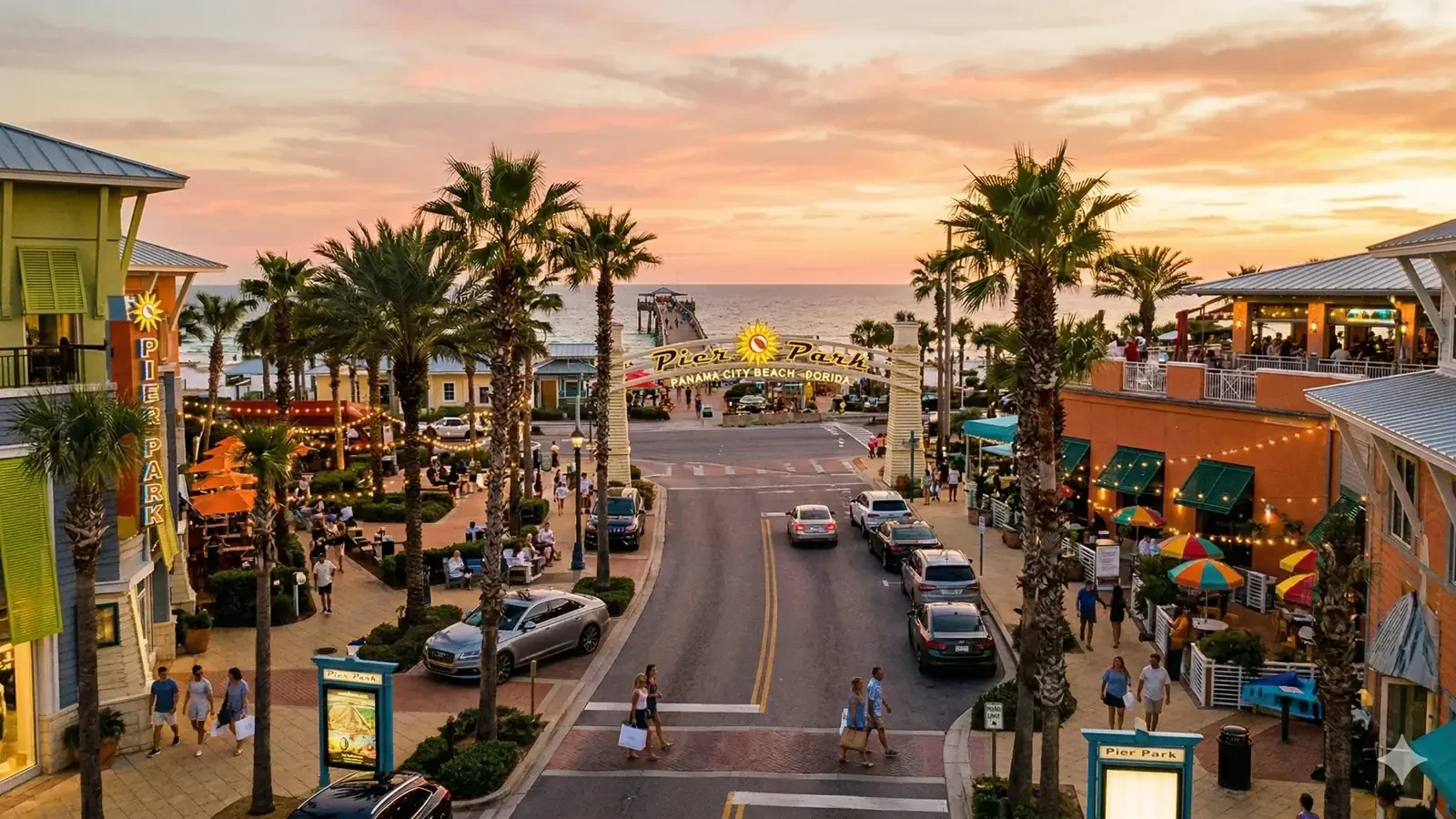
E-scooter rentals appear seasonally in PCB, mostly concentrated in the Pier Park and Front Beach Road tourist corridors. They are tourist-oriented and priced accordingly. Golf carts are legal on roads with speed limits of 35 mph or less, which covers significant portions of PCB’s residential and beachside streets.
Neither option is a commute solution. Golf carts cannot travel on Highway 98 or Back Beach Road where the speed limit exceeds 35 mph, which eliminates most cross-town trips. E-scooters have limited range and are not available year-round. Both are useful for short errands in specific neighborhoods — a grocery run in a golf cart community, a quick trip to dinner along Front Beach Road — but they do not replace a car for daily life.
Best for: Short errands in low-speed neighborhoods.
Pre-scheduled membership transportation
This is the newest category in PCB transportation and the one designed specifically for people who need reliable, repeatable rides. A pre-scheduled membership service works on a set schedule with confirmed availability and a fixed monthly price. You apply, set your schedule, and your rides are confirmed in advance — no requesting, no waiting, no surge.
Kova Mobility operates this model across Bay County. The coverage area includes Panama City Beach, Panama City, Lynn Haven, Callaway, and surrounding communities. Membership tiers vary by schedule and frequency. The service is built for daily commuters, shift workers, and anyone who cannot afford the unreliability of on-demand options.
Best for: Daily commuters, shift workers, anyone who needs guaranteed transportation.
See Kova Mobility’s coverage area and membership options. View service zones →
Matching the option to your situation
Here is the quick reference. Daily commute you cannot miss: pre-scheduled membership service. Occasional trip or errand: rideshare. Commute along a major corridor: Bay Town Trolley. Short distance in good weather: bike. Night out with friends: Party Pass. Short errand in a low-speed zone: golf cart.
Most people without a car in PCB use a combination of these. The key is knowing what each option does well and not expecting it to do what it wasn’t designed for. The trolley is not a rideshare. Rideshare is not a commute plan. A bike is not an all-weather vehicle. Match the tool to the trip, and getting around PCB without a car goes from impossible to manageable.
Disclaimer: This article is for informational purposes only. Kova Mobility is not affiliated with Bay Town Trolley, Uber, Lyft, or any third-party transportation provider mentioned. Fares, routes, and availability are approximate and subject to change. Verify current information directly with each provider.